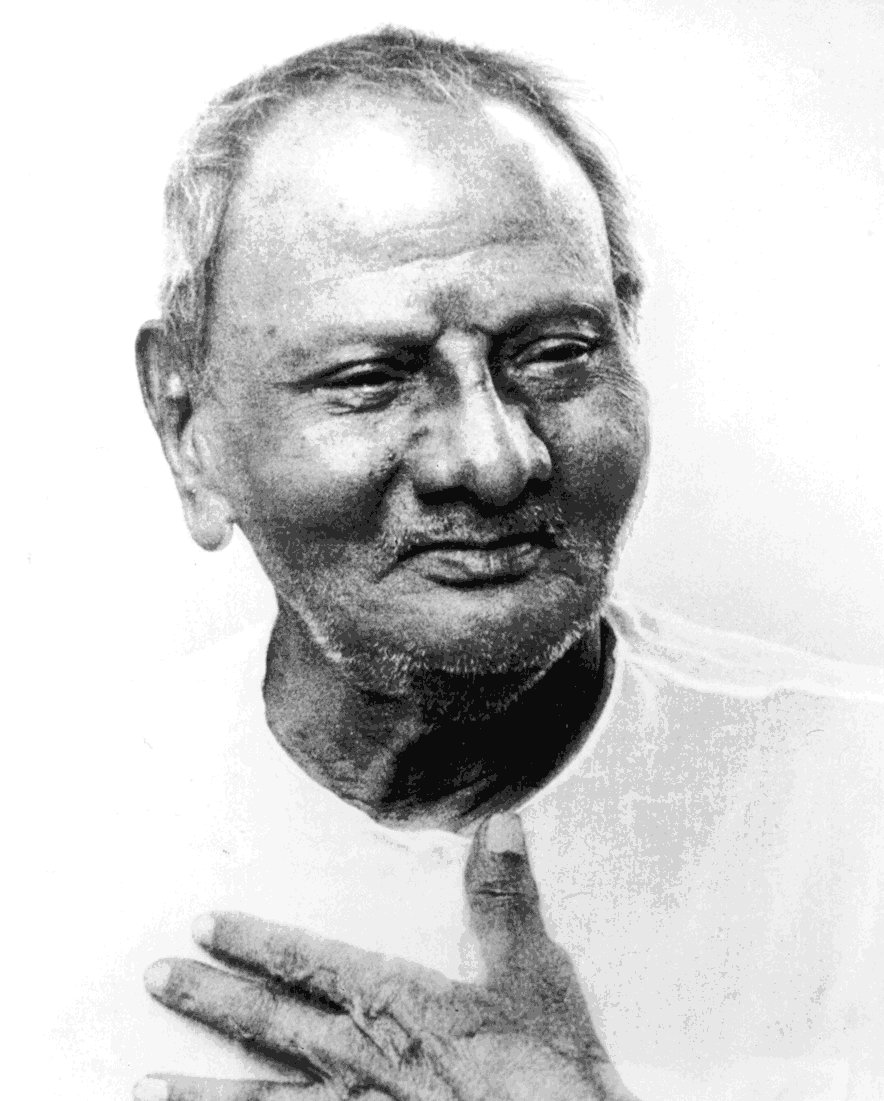
Teaching
He asks people to attend to the plain sense 'I am' and to see that they are not the body, the thoughts or the memories they identify with. He said his own guru gave him this instruction and that he followed it in his spare time. 1
Who it is for
For readers who like dense question-and-answer dialogue and a direct, unadorned approach to self-inquiry.
Life and places
- According to the biographical note in I Am That, relatives said he was born in March 1897; his father later farmed at Kandalgaon, a small village in Ratnagiri district of Maharashtra, and as a boy he helped him in the fields. 1
- After his father's death he followed his elder brother to Bombay, where he started a shop selling children's clothes, tobacco and hand-made cigarettes. 1
- He lived at Vanmali Bhuvan in Girgaon, Mumbai, in an attic of 15 by 10 feet, and by 1951 he had formally accepted the role of Sadguru in the Inchegiri lineage. 2
- He died on 8 September 1981; his last rites were performed the next day at Banganga in South Mumbai, where a marble samadhi temple in his memory now stands. 2
Public context
Works
-
I Am That
Book · 1973 · Chetana, Bombay
101 conversations with visitors to his room in Bombay, translated from Marathi tape recordings by Maurice Frydman. They return again and again to the sense 'I am' and to what one is not.
-
Seeds of Consciousness
Book · 1982 · Grove Press, New York
Talks from his last years, recorded on tape and edited by his student Jean Dunn. The first of three such volumes.
-
Prior to Consciousness
Book · 1990 · The Acorn Press, Durham, North Carolina
The second volume of talks from his last years, edited by Jean Dunn from tape recordings.
-
Consciousness and the Absolute
Book · 1994 · The Acorn Press, Durham, North Carolina
The third volume edited by Jean Dunn, with talks from the last months before his death in 1981.
The short summaries are ours.
In their own words
Short passages in the words of Nisargadatta Maharaj, each with its source. Where the quoted text is not in the language of this page, a translation follows and says whose it is.
-
The sense of being, of ‘I am’ is the first to emerge. Ask yourself whence it comes, or just watch it quietly. When the mind stays in the ‘I am’, without moving, you enter a state which cannot be verbalized but can be experienced.
I Am That · Chapter 1, The Sense of ‘I am’, p. 2 (Acorn Press paperback, 1988) · chetana.com Quoted translation: Spoken in Marathi; English translation from the tape recordings by Maurice Frydman, revised and edited by Sudhakar S. Dikshit. -
Did I ever tell you that you do not know and, therefore, you are inferior? Let those who invented such distinctions prove them. I do not claim to know what you do not. In fact, I know much less than you do.
I Am That · Chapter 2, Obsession with the Body, p. 4 (Acorn Press paperback, 1988) · chetana.com Quoted translation: Spoken in Marathi; English translation from the tape recordings by Maurice Frydman, revised and edited by Sudhakar S. Dikshit. -
When I met my Guru, he told me: ‘You are not what you take yourself to be. Find out what you are. Watch the sense ‘I am’, find your real self’. I obeyed him, because I trusted him. I did as he told me. All my spare time I would spend looking at myself in silence.
I Am That · Chapter 64, Whatever Pleases you, Keeps you Back, p. 301 (Acorn Press paperback, 1988) · chetana.com Quoted translation: Spoken in Marathi; English translation from the tape recordings by Maurice Frydman, revised and edited by Sudhakar S. Dikshit. Jean Dunn quotes the same words, with small differences in punctuation, in her foreword to Self-Knowledge and Self-Realization.
Documented teaching relationships
-
Personal teacher of Ramesh Balsekar
Ramesh Balsekar met Nisargadatta Maharaj in Mumbai after retiring from the Bank of India in 1977 and regarded him as his guru until Nisargadatta's death in 1981.
Stated by an institution · advaita.org , rameshbalsekar.com , enlightened-spirituality.org
-
Learned personally with Siddharameshwar Maharaj
A friend took Nisargadatta Maharaj to Siddharameshwar Maharaj of the Inchegiri branch of the Navnath Sampradaya, who initiated him, in 1933 according to Jean Dunn. He regarded him as his guru until and after Siddharameshwar's death in 1936.
Stated by an institution · nisargadattasamadhi.in , enlightened-spirituality.org , davidgodman.org
-
Personal teacher of Sailor Bob Adamson
Sailor Bob Adamson spent twelve months with Nisargadatta Maharaj in Bombay in 1976 and 1977, according to his official website.
Self-reported · sailorbobadamson.com
-
Personal encounter with Jack Kornfield
In his podcast Heart Wisdom (episode 332, 2026) Jack Kornfield recounts visiting Nisargadatta Maharaj in Bombay during his stays in India, sitting with the small group around him and listening to his teachings.
Self-reported · youtube.com
-
Personal teacher of Alexander Smit
In an interview recorded in 1988 Alexander Smit says that he met Nisargadatta Maharaj in September 1978, from then on attended all his talks and sometimes translated for visitors, and afterwards went to him every year for two or three months as often as he could.
Self-reported · spiritualteachers.org , web.archive.org
Teaching relationships are documented statements. They confer no trust and do not attest realisation.
Sources
- I Am That · Acorn Press paperback (1988, third printing 1992) His talks, translated from Marathi tape recordings by Maurice Frydman and edited by Sudhakar S. Dikshit; read in a PDF on a third-party website that states no permission; not compared with the Marathi recordings accessed 10 Oct 2026
- About Us · Shree Nisargadatta Samadhi Charitable Trust Trust of his disciples that maintains his memorial at Banganga, Mumbai; devotional accessed 10 Oct 2026
- Chetana Publishing Publisher's page of Chetana, Mumbai, the original publisher of I Am That; lists his books in print accessed 10 Oct 2026
Compiled by us from the sources listed. Last checked 11 Oct 2026.