Who it is for
For readers who want a short classical text on self-enquiry and do not mind Sanskrit terms.
Life and places
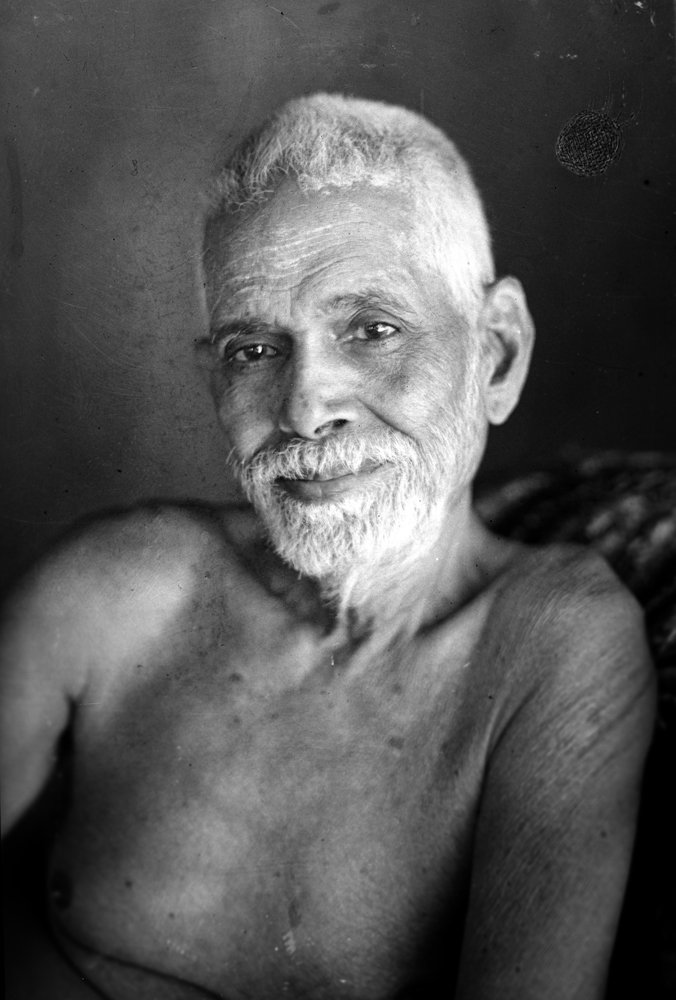
- He arrived at Arunachala on 1 September 1896, at the age of 16, and never left it. 4
- He stayed first in the great temple of Tiruvannamalai and at other places in the town, then in caves on the hill; he stayed longest, 17 years, in Virupaksha Cave on its southeastern slope. 4
- In 1916 his mother, Alagammal, came back to Tiruvannamalai to spend the rest of her life with him, and soon after he moved a little higher up the hill to Skandasramam. 4
- His mother died in 1922 and was buried at the foot of the hill; he later settled there for good, and so the ashram Sri Ramanasramam came into being, where he lived until his death in April 1950. 4
Works
-
Nan Yar? (Who Am I?)
Text · 1923 · Sri Ramanasramam
Ramana's answers, given in writing in 1902, to questions on self-enquiry from M. Sivaprakasam Pillai, who wrote them down from memory and first published them in Tamil in 1923. Editions have between 13 and 28 questions; Ramana later rewrote the text as an essay.
-
Ulladu Narpadu (Forty Verses on Reality)
Text · 1928
Forty verses on reality and the Self, composed in Tamil in 1928. Ganapati Muni rendered it into Sanskrit as Sat Darshanam in 1930.
-
Upadesa Undiyar (Upadesa Saram (The Essence of Instruction))
Text · 1927
Thirty verses on spiritual practice and its aim, composed in Tamil in 1927. David Godman counts it among the works Ramana wrote and checked himself.
The short summaries are ours.
In their own words
Short passages in the words of Ramana Maharshi, each with its source. Where the quoted text is not in the language of this page, a translation follows and says whose it is.
-
Even when extraneous thoughts sprout up during such enquiry, do not seek to complete the rising thought but instead, deeply enquire within, ‘To whom has this thought occurred?’
Words of Grace · Who Am I? (essay version), p. 5 · gururamana.org Quoted translation: English translation published by Sri Ramanasramam; translator not named in the edition. -
By the inquiry ‘Who am I?’. The thought ‘Who am I?’ will destroy all other thoughts, and like the stick used for stirring the burning pyre, it will itself in the end get destroyed. Then, there will arise Self-realization.
Nan Yar? (Who Am I?) · Question 10, 'How will the mind become quiescent?', pp. 18–19 (2010 edition) · gururamana.org Quoted translation: English translation published by Sri Ramanasramam; translator not named in the edition. -
Enquiring within, “Who is the seer?” I saw the seer disappearing, and that alone stands for ever.
Arunachala Ashtakam (Eight Stanzas to Sri Arunachala) · Verse 2 · gururamana.org Quoted translation: English translation published by Sri Ramanasramam; translator not named in the edition.
Documented teaching relationships
-
Personal teacher of H. W. L. Poonja (Papaji)
Godman's biography describes Papaji's personal relationship with Ramana.
Biographical tradition · davidgodman.org
-
Personal encounter with Yogi Ramsuratkumar
The Yogi Ramsuratkumar Ashram's biography says he came to Ramana's ashram in Tiruvannamalai, sat before Ramana Maharshi and went into higher states of consciousness under his gaze, before 1950.
Stated by an institution · yogiramsuratkumarashram.org
-
Personal teacher of Annamalai Swami
In his account recorded by David Godman, Annamalai Swami describes coming to Ramana Maharshi in 1928, serving as his attendant, receiving his name from him, and being told to practise self-enquiry.
Self-reported · davidgodman.org , davidgodman.org (2)
-
Personal encounter with Paul Brunton
According to the Paul Brunton Philosophic Foundation, Brunton's book A Search in Secret India describes his arrival at Ramana Maharshi's ashram and his time with him, and through his studies with Ramana he practised the 'Who am I' enquiry.
Stated by an institution · paulbrunton.org
-
Personal teacher of Sri Muruganar
Muruganar first visited Ramana Maharshi at Tiruvannamalai in September 1923, later settled near him and recorded his teachings in Tamil verse; Ramana checked and revised Guru Vachaka Kovai himself.
Biographical tradition · davidgodman.org , davidgodman.org (2) , swarajyamag.com
-
Personal encounter with U. G. Krishnamurti
In his own account in The Mystique of Enlightenment, U. G. Krishnamurti visited Ramana Maharshi once and asked him whether he could give him what he had; his friends' timeline dates the meeting to December 1939.
Self-reported · ugkrishnamurti.in , ugkrishnamurti.in (2)
-
Personal encounter with Paramahansa Yogananda
Talks with Sri Ramana Maharshi records that Swami Yogananda came to Sri Ramanasramam with four others on 29 November 1935, had lunch there and asked Ramana Maharshi questions before leaving; his organisation names Ramana Maharshi among those he met in India in 1935–36.
Stated by an institution · archive.arunachala.org , yssofindia.org
-
Personal teacher of Sri Sadhu Om
Michael James writes that Sadhu Om lived with Ramana Maharshi for less than five years.
Biographical tradition · sriramanateachings.org
-
Personal encounter with Swami Abhishiktananda (Henri Le Saux)
The Abhishiktananda Centre records that Henri Le Saux, later Swami Abhishiktananda, had his first darshan of Ramana Maharshi at Sri Ramana Ashram in Tiruvannamalai on 24 January 1949 and a second darshan in August 1949.
Stated by an institution · abhishiktananda.org.in , ajatananda.org
-
Personal encounter with Swami Ramdas (Papa Ramdas)
Anandashram says Swami Ramdas visited Ramana Maharshi at his ashram at the foot of the hill in Tiruvannamalai, asked for his blessing and received it through Ramana's gaze.
Stated by an institution · anandashram.org
-
Personal encounter with Narayana Guru
An account on the archive of Arunachala Ashrama, compiled from a report by Swami Mangalananda of 1948 and later articles, says that Narayana Guru visited Ramana Maharshi at Skanda Ashram in Tiruvannamalai in 1916 and accepted Ramana's invitation to the midday meal. During the visit he composed the five verses Nirvrutti Panchakam, which his disciple Swami Vidyananda offered to Ramana.
Biographical tradition · archive.arunachala.org
Teaching relationships are documented statements. They confer no trust and do not attest realisation.
Sources
- Who Am I? The Teachings of Bhagavan Sri Ramana Maharshi, eighth edition 2010 · Sri Ramanasramam The ashram's own English edition (28 questions and answers, introduction by T. M. P. Mahadevan); translator not named accessed 9 Oct 2026
- Words of Grace, fourth edition 2005 · Sri Ramanasramam The ashram's own English collection of three early prose works; translators not named accessed 9 Oct 2026
- The authenticity of Bhagavan's recorded teachings, part 1 · David Godman Long-time devotee and editor of Ramana books; detailed account of how each text came about; his own judgements accessed 9 Oct 2026
- At Arunachala · Sri Ramanasramam The ashram's own account of his years at Tiruvannamalai and on the hill; devotional in tone accessed 10 Oct 2026
Compiled by us from the sources listed. Last checked 10 Oct 2026.